Number 7: A Festive, Thoughtful Digit for Real Embroidery Projects
First Impression: Cheerful, Balanced, and Quietly Sophisticated
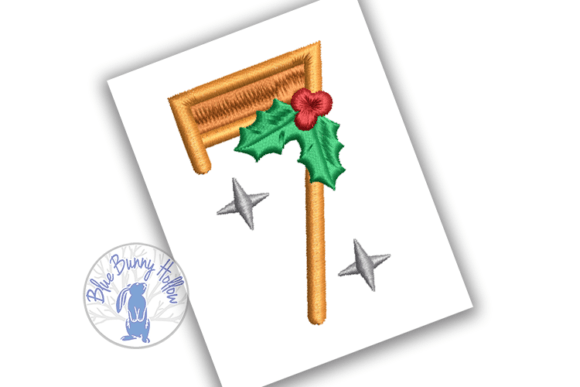
When I opened Number 7, my first thought wasn’t “cute holiday number”—it was “this feels intentional.” The digit itself has clean, confident curves with just enough weight to hold its own on fabric. What elevates it beyond a basic numeral is the integration of holly leaves and berries: not tacked on as afterthoughts, but growing *from* the shape—curling off the crossbar, dotting the upper curve like tiny ornaments. It reads as festive without shouting. That matters when you’re designing for real people who want warmth, not clutter.
A Real-World Test: Embroidering It on a Linen Tea Towel for a Boutique Holiday Gift Set
Last week, I stitched Number 7 onto a natural linen tea towel—part of a small-batch holiday collection for a local gift shop. I used medium-weight cutaway stabilizer and 40-weight polyester thread in deep forest green and glossy red. The result? Crisp holly details held up beautifully, the satin stitch on the berry highlights caught light subtly, and the fill stitch in the number’s body stayed smooth, not puffy or stiff. Customers noticed it immediately—not because it was loud, but because it felt *considered*. One buyer said, “It makes me think of my grandmother’s Christmas kitchen.” That’s the quiet power of this design: it invites memory, not just decoration.
Where Number 7 Shines (and Where It Asks for Care)
Number 7 works exceptionally well on structured, stable fabrics: cotton twill aprons, medium-knit sweatshirts, canvas tote bags, and linen pillow covers. Its moderate detail level means it scales cleanly from 3.5" to 5.5" without losing definition—ideal for both baby embroidery (think onesies or nursery wall hangings) and larger commercial embroidery projects like boutique staff uniforms or holiday market merchandise.
That said, it’s not a “throw-it-on-and-go” design for every surface. On highly textured fabrics—like bouclé knit or heavy terry cloth—the delicate holly veins may soften or blur unless you increase stabilizer support. On stretchy fabrics (e.g., ribbed cotton tees), I recommend basting the hoop tightly and using tear-away + light cutaway combo—otherwise, the slight tension in the leaf stems can distort under fabric movement. And while the berries read clearly on light backgrounds, test them on dark fabric with high-contrast thread: some reds mute on navy or charcoal unless you choose a brighter, more saturated tone.
Curved surfaces—like the front of a structured cap—require extra attention. The top curve of the number and the upward sweep of the holly leaves can compress or skew if hooped too loosely. I always reposition the design slightly lower on the cap front and reduce density by 5–8% in the upper third during digitizing prep—just enough to keep the shape true without sacrificing richness.
What This Design Says About Your Craft—and Your Customers’ Trust
Using Number 7 in your handmade product isn’t just about adding a number—it’s about signaling intentionality. In a sea of generic holiday embroidery files, this one stands out because it balances symbolism (holly = tradition, resilience, celebration) with modern restraint. That resonance translates directly to customer trust. Etsy sellers tell me buyers comment on “how thoughtful” their personalized gifts feel—and that often traces back to subtle, cohesive details like these.
For craft business owners, Number 7 supports brand consistency without demanding rigid repetition. Pair it with a simple monogram, a minimalist tree, or even plain text (“2024”) on matching items—and the shared visual language feels curated, not templated. It also photographs beautifully in printable mockups, especially flat-lay shots with natural light and warm-toned props. That boosts engagement across social media and digital storefronts where first impressions happen in under two seconds.
Practical Designer Notes Before You Stitch
- Always test on scrap fabric first—especially if stitching on a new fabric blend or using unfamiliar thread colors.
- Review stitch density: The holly elements use fine satin and running stitches; if your machine struggles with dense areas, check whether the file allows for minor density adjustment before final hooping.
- Confirm hoop size compatibility: While Number 7 fits standard 4x4 hoops at smaller sizes, scaling up for a pillow cover or tote bag may require a 5x7 or larger—verify your machine’s max dimensions.
- Inspect small details under magnification: The berry highlights and leaf tips are intentionally delicate—ensure they’re fully digitized and won’t vanish at smaller scales.
- Test black-and-white mockups: Does the contrast hold? Does the shape remain legible without color cues? This predicts how well it’ll translate to embroidered patches or monochrome branding.
- Use proper stabilizer: Medium cutaway for knits, lightweight tear-away for stable wovens, and fused + cutaway for layered garments like reversible aprons.
- Check licensing terms carefully before selling finished products or bundling Number 7 into digital embroidery bundles—commercial use rights vary widely across platforms.
Final Thought: Not Just a Number—A Narrative Anchor
In my 12 years reviewing embroidery files for designers and small shops, I’ve seen how a single well-chosen digit can anchor an entire holiday collection—whether it’s “7” for a seventh birthday, a lucky number for a wedding gift, or simply the quiet rhythm of a seasonal countdown. Number 7 doesn’t try to do everything. It does one thing beautifully: it turns a numeral into a moment. That’s rare. And for anyone building a craft business, personalizing gifts, or launching a holiday line, that kind of quiet strength is worth more than flash.