Ballerina Ballet Shoes Slippers
A Graceful Stitch, Not Just a Pretty Outline
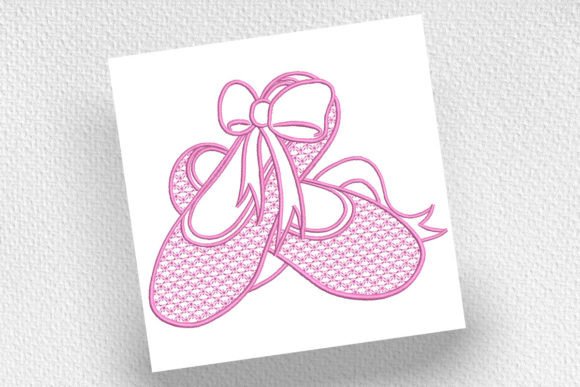
When I first opened the Ballerina Ballet Shoes Slippers embroidery file, what struck me wasn’t just the silhouette—it was the implied movement. This isn’t a stiff, symmetrical logo or a cartoonish prop; it’s a machine embroidery design that breathes like a dancer mid-pirouette. The curve of the satin bow, the subtle taper of the shoe’s toe, the gentle lift of the heel—all suggest lightness and intention. As someone who’s stitched hundreds of dance-themed designs for Etsy sellers, boutique apparel lines, and custom baby keepsakes, I know how easily ballet motifs can slip into cliché. But this one avoids it. It feels hand-drawn in thread—not overly detailed, not too sparse—just enough to read clearly at 3–4 inches wide on a finished product.
Where It Lives Best: Real Projects, Real Reactions
Last week, I used Ballerina Ballet Shoes Slippers on a set of organic cotton tea towels for a local dance studio’s holiday pop-up. We paired it with soft blush thread on ivory linen-cotton blend fabric, stabilized with medium-weight tear-away. The result? Customers paused. Not just glanced—they *touched* the stitch texture, smiled, and asked, “Is this for my daughter’s recital?” That’s the quiet power of this design: it reads as both personal and professional. It works equally well as a single motif on a toddler’s onesie (centered above the chest), a minimalist patch on a denim tote bag, or a delicate accent on the cuff of a knit sweater. For small shop owners, it adds instant thematic cohesion—no extra branding needed. For craft fair vendors, it elevates a plain sweatshirt into a meaningful personalized gift without overwhelming the garment.
What Holds Up—and What Needs Thought
The design’s strength lies in its intelligent simplicity. The satin stitch outlines are clean and fluid, not jagged or over-digitized. Fill stitches in the shoe body are moderate in density—enough to hold shape on stable fabrics, but not so heavy that they’ll pucker thin knits or distort stretchy jersey. That said, I wouldn’t push it onto a curved cap front without testing first: the bow’s delicate loops could compress or lose definition on tight radii. And while it shines on light-to-mid-tone fabrics, on deep charcoal or navy, you’ll want to verify contrast—especially if stitching in white or pale pink thread. A quick black-and-white mockup saves time here.
For baby embroidery, it’s ideal—but only on pre-washed, tightly woven cottons. Skip ribbed knit bodysuits unless you’re using lightweight cutaway stabilizer and reducing top tension. On textured fabrics like terry cloth or bouclé, the fine details in the ribbon folds may soften. That’s not a flaw—it’s a reminder that every embroidery file interacts with material. This one asks for thoughtful pairing, not brute-force application.
Stitching Clarity = Customer Trust
In my experience, buyers don’t just buy a design—they buy the *assurance* that it will look intentional and polished when finished. Ballerina Ballet Shoes Slippers delivers that quietly. There’s no tiny text to fail at small scale, no nested applique layers that demand precision trimming, no dense fill areas that trap lint or resist washing. That translates directly to fewer returns, more repeat Etsy orders, and stronger brand consistency for shops selling coordinated nursery decor or dance camp merchandise. When stitched cleanly, it reads as handmade—not mass-produced—and that perception lifts perceived value. A customer paying $48 for an embroidered pillow cover doesn’t just see thread; they see care, continuity, and craft. This design supports that narrative without shouting.
Practical Notes Every Designer Should Run Through
- Test first—on scrap fabric matching your final substrate, with the same stabilizer and thread colors you plan to use.
- Check stitch density in the bow’s center and sole edge—moderate is good, but confirm it doesn’t feel stiff or brittle after washing.
- Confirm hoop size before digitizing any companion elements (like a name or date)—the design should fit comfortably within your standard hoop with room to spare.
- Inspect small details under magnification: the loop of the ribbon, the curve where heel meets sole—do they resolve cleanly at your target size?
- Try it in grayscale mockups—this reveals contrast issues faster than color previews.
- Use proper stabilizer: medium tear-away for stable wovens, lightweight cutaway for knits, and avoid heavy fusibles that mute the delicate line work.
- Verify licensing before listing as a digital embroidery file or attaching to physical products for resale—commercial use rights aren’t implied.
More Than a Motif—A Quiet Signature
I’ve seen dozens of ballet shoe designs cross my workspace—some overly ornate, some too generic to stand out, some technically flawed in stitch logic. Ballerina Ballet Shoes Slippers sits in that rare middle ground: expressive but restrained, elegant but executable, thematic but versatile. It doesn’t scream “dance!”—it whispers it, confidently. That makes it unusually flexible: perfect for a wedding gift (embroidered on a silk scarf), a graduation keepsake (stitched inside a leather journal cover), or even subtle branding on a studio’s staff aprons. For Etsy sellers building a cohesive collection, it pairs beautifully with simple monograms or soft watercolor-style florals—not competing, complementing.
Ultimately, this isn’t just another embroidery file. It’s a tool for storytelling—one stitch at a time. Whether you’re stitching for a child’s first recital, launching a small shop’s debut line, or adding quiet sophistication to custom apparel, Ballerina Ballet Shoes Slippers earns its place in your design assets because it works—consistently, gracefully, and without fuss.