Clown Border: A Playful Brand Asset for Small Business Merch
First Impression: Friendly, Bold, and Unmistakably Handmade
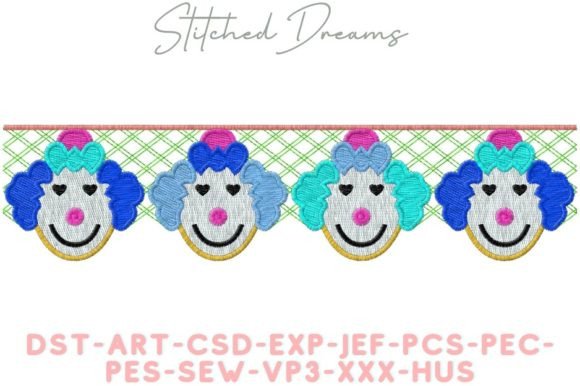
As an embroidery designer who’s digitized and stitched over 2,000 small business projects—from neighborhood bakeries to indie pet brands—my first read on Clown Border is immediate: it’s joyful without being juvenile, detailed without sacrificing clarity, and undeniably handmade in spirit. The title “Playful Clown Border” signals approachability and charm—not circus kitsch or cartoon overload. That matters deeply when you’re building brand identity through custom apparel or embroidered patches. For a florist adding whimsy to aprons, a creative studio branding tote bags, or a café embroidering staff caps, Clown Border lands as friendly professionalism—not gimmickry.
Real-World Performance Across Merchandise Types
In practice, Clown Border shines where personality meets purpose. As an embroidered patch, its repeating clown motif creates visual rhythm—ideal for sew-on labels on handmade product packaging or boutique merchandise tags. On staff apron embroidery, it works beautifully along the hem or pocket edge, offering consistent branding without overwhelming function. For cap embroidery, the border structure adapts well to curved fronts when digitized with appropriate underlay and pull compensation—just avoid placing it too low near the bill seam. As a tote bag design, it frames logos elegantly along the top or bottom edge, elevating everyday carry into branded customer gifts.
It also performs strongly on custom apparel like work shirts and sleeve accents—especially for businesses that lean into playful authenticity (think: a toy shop owner, a children’s book illustrator, or a vintage-themed gift boutique). Because it’s a border, not a central logo, it supports rather than competes with primary branding. That flexibility makes it a smart addition to your design assets library—not just a one-off decoration.
Where to Use Clown Border Thoughtfully
Like any strong machine embroidery design, Clown Border demands intentionality in execution. Avoid scaling it down below 2.5 inches wide for small patch sizes—clown facial details may blur or stitch poorly on dense fabrics. On curved surfaces like cap fronts or knit tote handles, confirm the digitizing includes stretch compensation; otherwise, distortion can flatten expression and weaken recognition. Dark uniforms require high-contrast thread colors: pair bright reds, yellows, or teals with white or light gray base fabric to preserve cheerfulness. And never skip testing on your actual fabric texture—a fluffy fleece or heavy canvas may swallow fine outlines unless stabilizer choice and stitch density are adjusted.
Also consider longevity: if your finished product endures frequent washing (like café aprons or daycare staff shirts), verify that the stitch density isn’t so tight it risks thread breakage or fabric puckering over time. When in doubt, request a stitch file sample—or better yet, run a test on scrap fabric before full production.
Impact on Brand Identity and Customer Connection
Clown Border doesn’t just decorate—it communicates. Its consistent, repeating motif builds visual consistency across touchpoints: a patch on a tote, a subtle border on a sleeve, a framed label on artisan soap packaging. That repetition strengthens recall. Customers remember the cheerful rhythm—not just the logo. For Etsy sellers and handmade brands, that emotional resonance translates directly to trust: it signals care, craft, and human-centered values—not mass-produced sterility.
Importantly, it elevates perceived value. A well-executed embroidered patch with thoughtful design like Clown Border reads as premium—even on modest materials. It tells customers, “This isn’t generic. This was chosen—and stitched—with intention.” That nuance matters when differentiating from big-box competitors or algorithm-driven marketplaces.
Practical Designer Notes Before You Stitch
Before committing Clown Border to commercial embroidery, follow these field-tested steps:
- Test in black and white first—to assess contrast, spacing, and silhouette clarity without color distraction.
- Check minimum viable size—does it retain legibility at your intended hoop size and application? If using for cap fronts, aim for ≥3 inches wide.
- Review thread color contrast—especially against dark or textured substrates. Bright accents pop best on light cotton, linen, or twill.
- Inspect spacing between clowns—tight repeats risk thread nesting; generous gaps allow breathability and cleaner wash performance.
- Confirm stabilizer pairing—lightweight cutaway for stable wovens; tear-away + topping for knits or fuzzy fabrics.
- Always test on real fabric—mockups lie. What looks crisp on screen may shift on denim or shrink on organic cotton.
- Create a printable mockup for client approval—show placement, scale, and thread palette side-by-side with other design assets.
- Compare beside your core logo—does Clown Border complement tone and proportion, or compete?
- Verify commercial licensing—since this is a digital embroidery file intended for small business merch, ensure usage rights cover resale, promotional use, and physical product labeling.
Final Thought: More Than a Border—A Branding Bridge
Clown Border isn’t just another embroidery file. In the hands of a small business owner or apparel decorator, it’s a versatile, emotionally intelligent tool—bridging playfulness and professionalism, handmade warmth and commercial polish. Whether anchoring a bakery’s apron line, framing a florist’s gift tag, or adding signature charm to a pet brand’s tote collection, it delivers joy *with intention*. That’s the hallmark of smart Clothing and Embroidery design: not just what it looks like—but how it works, wears, and connects. Stitch it right, and Clown Border won’t just border your products—it’ll broaden your brand’s appeal.