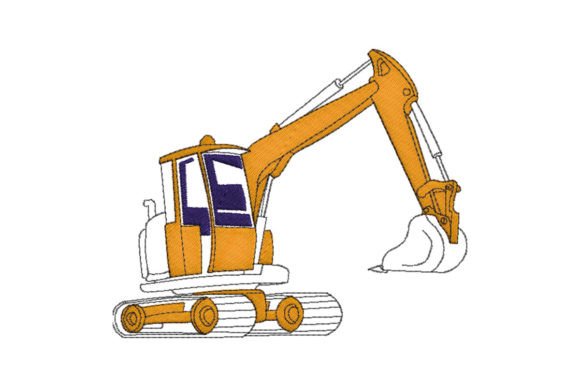
Construction Excavator
A Practical Embroidery Designer’s Review for Small Business Merchandise
As an embroidery designer who’s developed and tested hundreds of machine embroidery designs for small businesses—from neighborhood bakeries to indie craft studios—I approached Construction Excavator with a specific question: Does this design translate beyond visual appeal into real-world brand utility? The answer hinges less on artistic flair and more on how well it functions across patches, uniforms, caps, totes, aprons, and product packaging. Let’s break it down—not as decoration, but as business infrastructure.
First Impression: Industrial Clarity, Not Just Grit
From the title alone—Construction Excavator—you expect boldness, weight, and motion. The description confirms it: “captures the powerful and industrial essence” and “brings the dynamic energy of construction.” That’s promising. In practice, this isn’t a cartoonish or overly stylized excavator—it reads as professional, grounded, and purpose-built. It avoids looking playful or decorative, which matters immensely for businesses wanting to signal competence (think: local contracting firms, hardware co-ops, or tool rental shops) or intentional contrast (a florist using it ironically on a denim apron, or a coffee roaster branding its “ground crew” tote bags). It leans modern-classic—not retro, not futuristic—but timelessly functional.
Where Construction Excavator Shines in Real Business Use
This design excels where clarity, durability, and instant recognition matter most:
- Embroidered patches: Holds up beautifully at 2.5"–3.5" sizes—ideal for sew-on or iron-on application on jackets, tool belts, or boutique merchandise tags.
- Staff uniforms and work shirts: Works cleanly on left-chest placement without overwhelming the garment; reads confidently from 6+ feet away.
- Cap embroidery: Performs well on structured front panels when digitized with appropriate underlay and reduced density—no puckering on curved crowns.
- Tote bag design: Scales effectively to 4"–5" width on cotton canvas or heavy-duty poly-blend bags—adds authority without sacrificing approachability.
- Apron embroidery: Anchors the upper chest or pocket area with visual weight that complements handmade product presentation, especially for makers’ markets or studio shops.
- Product packaging accents: Translates cleanly to stitched labels on reusable tool rolls, branded safety gear, or limited-edition workshop kits.
For Etsy sellers and crafters, Construction Excavator offers instant narrative—it tells customers, “This is built to last,” even when applied to non-construction products like ceramic mugs, leather journals, or planters.
Use With Intention: Where Caution Applies
Like any strong design, Construction Excavator demands thoughtful execution—not just placement, but preparation:
- Avoid sub-2" patch sizes unless the file includes a simplified alternate version—fine outlines and mechanical detail may blur or stitch poorly below that threshold.
- Test carefully on dark uniforms: High-contrast thread colors (e.g., bright yellow or white) are essential for legibility—don’t assume default digitizing accounts for low-light fabric.
- Curved surfaces (like cap fronts or rounded tote handles) require proper stabilizer selection—cutaway + tear-away combo prevents distortion.
- Frequent-wash items (aprons, work shirts) benefit from moderate stitch density—overly dense fills increase wear risk and stiffness.
- Textured fabrics (twill, canvas, duck cloth) may obscure fine line work; consider slightly bolder outlines if your digitizing allows adjustment.
Brand Identity Impact: More Than Just a Logo
Construction Excavator does more than identify—it positions. For a small business, that means:
- Trust through precision: Clean lines and balanced proportions suggest attention to detail—valuable for service-based brands (e.g., home inspectors, HVAC techs).
- Recognition without repetition: Its distinct silhouette stands out among generic text logos or abstract marks—especially effective for event merch or pop-up booths.
- Visual consistency across touchpoints: Whether stitched on a cap, printed on a mockup, or laser-etched beside a QR code, its structure holds up.
- Handmade product alignment: When used by crafters or studios, it subtly reinforces values of skill, labor, and tangible creation—without needing words.
- Buyer engagement: Customers respond to authenticity—this design feels earned, not trend-chasing. That builds resonance over time.
Essential Embroidery Designer Notes Before Production
Before committing to bulk runs or client delivery, run these checks:
- Test the Construction Excavator embroidery file in black and white first—assess contrast and readability without color bias.
- Verify performance at your target patch size—run a 2.75" test on actual fabric before finalizing.
- Review thread color recommendations against your brand palette—don’t default to stock suggestions without comparing them on physical swatches.
- Inspect spacing between key elements (e.g., boom arm and cab)—tight gaps can collapse during stitching on stretchy or unstable fabrics.
- Confirm hoop size compatibility with your primary machines—some Work category files assume larger commercial hoops.
- Always test on the exact fabric you’ll use—especially for custom apparel or apron embroidery—using the same stabilizer and tension settings.
- Create a printable mockup for client approval—showing scale, placement, and thread color options builds confidence before stitching begins.
- Compare Construction Excavator alongside your other design assets—does it harmonize visually with your wordmark or secondary icons?
- Double-check commercial licensing terms—since this is intended for small business merch and embroidered patch production, confirm usage rights cover resale, distribution, and digital embroidery file integration.
Remember: A strong machine embroidery design like Construction Excavator isn’t just about what it looks like—it’s about how reliably it carries your brand across every stitch, surface, and sale. Done right, it becomes part of your business’s quiet credibility—solid, steady, and unmistakably yours.