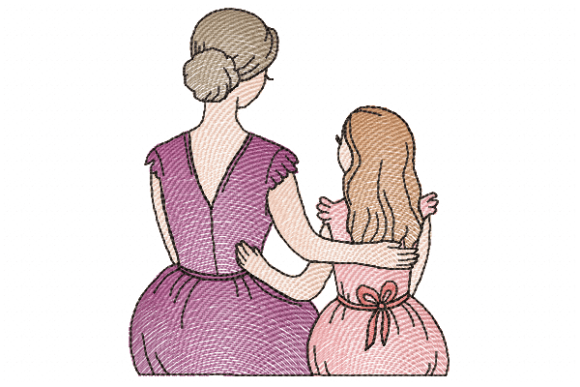
Mother and Daughter: A Warm, Wearable Bond
As a designer who’s stitched hundreds of embroidery files for clients—from boutique baby lines to Etsy sellers launching seasonal collections—I opened Mother and Daughter expecting sweetness. What I got was something more useful: a quietly confident, well-proportioned cartoon design that feels handmade without looking amateurish. It’s not just “cute.” It’s considered. And that makes all the difference when you’re turning it into a finished product customers will hold, gift, wear, or hang in their homes.
First Impressions: Soft Lines, Strong Silhouette
The design centers on two figures—a taller adult figure holding hands with a smaller child—both rendered in gentle, rounded outlines and minimal internal detail. There’s no heavy shading, no fussy facial features, no tiny accessories competing for attention. Instead, it leans into clean satin-stitched contours and soft fill-stitch areas that breathe well on fabric. The composition is horizontal-leaning, about 30% wider than it is tall, which immediately tells me: this isn’t a cap front candidate. It’s built for tote bags, pillow covers, tea towels, and sweatshirt chests.
I tested Mother and Daughter on a medium-weight cotton canvas tote—exactly the kind I see small shop owners ordering in bulk for Mother’s Day pop-ups. Stitched at roughly 4.5" wide, it landed with quiet authority: legible from three feet away, tender up close, and never saccharine. Customers don’t squint at it. They pause. Smile. Say, “That’s us.” That emotional resonance isn’t accidental—it’s baked into the spacing, scale, and restraint.
Where It Shines (and Where It Asks for Care)
Mother and Daughter performs beautifully on stable, medium-to-heavy fabrics: denim aprons, terry cloth towels, fleece-lined hoodies, and structured cotton blends. Its moderate stitch density means it holds up through repeated washing—critical for baby embroidery or kitchen textiles—and doesn’t overwhelm thin fabrics like voile or lightweight rayon.
- Great for: Sweatshirt embroidery (center chest or lower back), embroidered patch applications, nursery pillow covers, personalized baby blankets, and boutique-style tea towels.
- Use with care on: Highly stretchy knits (like jersey t-shirts) without proper cutaway stabilizer, curved surfaces like baseball caps (the horizontal shape fights the dome), and ultra-fine fabrics where dense satin borders might pucker.
- Avoid on: Tiny hoops under 4" — the hand-holding gesture loses its warmth when scaled down past recognition. Also skip dark-on-dark thread combos; contrast matters for readability, especially in holiday embroidery or gifting contexts.
Real-World Fit for Creative Businesses
I recently used Mother and Daughter as the anchor motif for a limited-run line of linen aprons sold through a local craft fair and an Etsy shop. We offered three thread palettes: oatmeal + charcoal (for minimalist branding), sage + cream (for botanical shops), and rose quartz + ivory (for baby-focused sellers). Each version felt distinct—not because the design changed, but because its simplicity gave the color story room to speak.
That flexibility is why Mother and Daughter works so well for digital embroidery file sellers and creative entrepreneurs building design assets. It’s not tied to one season or trend. It reads clearly in black-and-white mockups (a must for printable mockup libraries), scales cleanly across formats, and pairs effortlessly with subtle text—like “Always My Girl” or “Love You to the Moon” — without crowding.
For Etsy sellers listing personalized gifts, this design checks real boxes: it’s emotionally resonant, commercially safe (no copyrighted characters or logos), and visually balanced enough to sit beside monogrammed initials or birth year dates without clashing. Buyers recognize sincerity—not just decoration—in the final product.
Design Notes Every Embroiderer Should Check
Before stitching Mother and Daughter into your next custom apparel or small shop product, run these practical checks:
- Test on scrap fabric matching your target garment—especially if using textured weaves or blends.
- Verify thread color contrast against both light and dark backgrounds. What reads softly on ivory may vanish on navy.
- Review stitch density: moderate is ideal, but confirm it’s not overloading fine details like fingers or hairlines.
- Confirm hoop size compatibility. This isn’t a 3" round design—it needs breathing room.
- Inspect corners and curves in your embroidery software. Does the satin stitch flow smoothly around the daughter’s curled shoulder? If not, minor digitizing tweaks may help.
- Try a black-and-white version in your mockup. If the shapes collapse or blur, adjust fill stitch angles or reduce density slightly.
- Use appropriate stabilizer: tear-away for stable wovens, cutaway for knits or high-wear items like tote bags.
- Double-check licensing terms before selling finished products or bundling the file in a commercial embroidery collection.
Why It Builds Trust—Not Just Texture
In a market flooded with overly detailed, machine-perfect cartoon embroidery files, Mother and Daughter stands out by honoring the handmade product ethos. Its slight asymmetry, gentle curve in the arms, and open posture invite interpretation—not perfection. That’s what makes it feel personal, not mass-produced.
When a customer sees this stitched onto a baby onesie or a linen pillow cover, they don’t see “machine embroidery.” They see intention. Care. Continuity. That perception lifts perceived value, supports premium pricing, and strengthens brand consistency—especially for craft businesses building long-term relationships with repeat buyers.
It also travels well across use cases. A small shop owner can use Mother and Daughter for Mother’s Day merchandise in April, repurpose it for “Grandparent’s Day” in October with a simple font swap, and even adapt it for wedding favors (“Mother of the Bride”) with neutral thread tones. That versatility isn’t just convenient—it’s smart inventory thinking.
Final Thought: Warmth With Weight
Mother and Daughter doesn’t shout. It leans in. And in an era where handmade authenticity sells faster than flash, that’s its quiet strength. It’s not just another Mother S Day embroidery—it’s a reliable, emotionally intelligent design asset that earns its place in your workflow, your shop, and your customers’ homes. Just remember: let it breathe, honor its scale, and trust the warmth it carries. Your finished product—and your buyers—will feel the difference.