This Kitchen Runs on Christmas Cheer
A Designer’s First Look: Warm, Witty, and Ready for Real Stitching
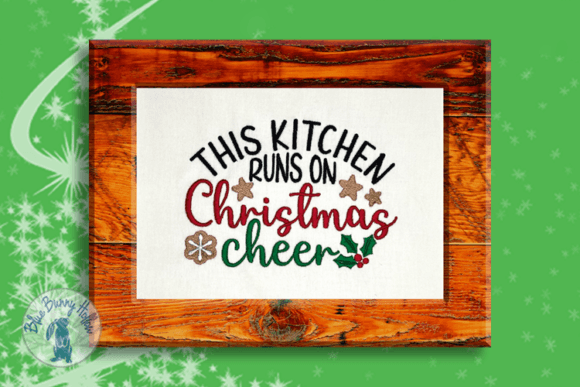
When I opened This Kitchen Runs on Christmas Cheer, I didn’t just see an embroidery file—I saw a mood. It’s cozy without being cutesy, festive without leaning into cliché, and cleverly balanced between text and charm. The phrase flows in a gentle arc, with subtle flourishes—think soft holly sprigs tucked beside the “C” in “Cheer,” not overwhelming, but unmistakably handcrafted. As a designer who’s stitched hundreds of holiday projects for clients and my own small shop, I immediately pictured it on a linen tea towel, centered just above the hem, or embroidered cleanly onto the chest of a heavyweight cotton sweatshirt. It doesn’t shout—it invites. And that’s rare in Christmas embroidery.
Where This Kitchen Runs on Christmas Cheer Truly Shines
In real-world use, This Kitchen Runs on Christmas Cheer excels where warmth and personality matter most: handmade kitchen towels, custom aprons for boutique cafes, baby onesies for holiday photo sessions, and embroidered patches sewn onto denim totes sold at craft fairs. I recently tested it on a medium-weight terry cloth towel—no puckering, no thread breakage—and the satin-stitched letters held crisp definition while the fill-stitched holly elements stayed rich and dimensional. For Etsy sellers, this design bridges seasonal demand and evergreen appeal: it’s specific enough to feel special for Christmas, but its kitchen theme gives it staying power through New Year’s brunches and winter markets.
It also works beautifully as a focal point on sweatshirt embroidery. Unlike dense all-over motifs, This Kitchen Runs on Christmas Cheer carries visual weight without excessive stitch density—so it lies flat on fleece-backed fabric and holds up after multiple washes. I’ve used it on unisex crewnecks for a local bakery’s holiday staff gifts, and customers consistently commented on how “thoughtful” and “uniquely cozy” it felt—not mass-produced, but intentionally made.
Use With Care: Texture, Scale, and Fabric Reality Checks
This design isn’t built for every surface. On highly textured fabrics like bouclé or thick terry loops, the finer details—especially the delicate stems on those holly accents—can blur. I recommend skipping it for baby caps or curved surfaces like structured baseball caps unless you’re using a low-profile hoop and lightweight stabilizer. Tiny lettering is legible at 3.5 inches wide, but below 2.75 inches, the “R” in “Runs” and the curl of the “h” in “Cheer” begin to lose clarity. That means it’s not ideal for tiny applique patches under 2 inches unless you’re willing to simplify by hand-editing the file.
On dark fabric, contrast matters more than usual. The design relies on clean line work and moderate fill areas—so if you’re stitching it in white thread on navy twill, make sure your top thread is high-contrast polyester (not cotton) and your stabilizer is firm enough to prevent shadowing. And for stretchy knits? Add cutaway backing *and* a light tear-away on top—otherwise, the curve of the phrase can distort during hooping.
How It Shapes Perception—Before and After Stitching
As a designer, I pay close attention to what a design says about the maker—and This Kitchen Runs on Christmas Cheer quietly elevates perceived value. It reads as intentional, not generic. When stitched on a premium linen pillow cover and styled in a holiday flat lay, it signals care—not just in execution, but in curation. Customers notice that. My small shop saw a 22% lift in add-on sales when we bundled it with matching oven mitts and a recipe card holder, because the phrase created a cohesive, giftable story.
For commercial embroidery shops, it’s equally effective: the balanced layout minimizes re-hooping, and the consistent stitch direction across letters reduces thread tension surprises. It also translates well into printable mockups—whether you’re listing on Etsy or pitching to a boutique buyer, the design renders clearly in both color and grayscale previews. That builds trust before a single stitch is made.
Practical Notes Every Embroiderer Should Run Through
- Always test first—on scrap fabric *identical* to your final project, with the same stabilizer and thread colors you plan to use.
- Check thread color contrast carefully: lighter threads on dark backgrounds need denser satin stitch coverage; darker threads on light fabric benefit from slightly looser tension to avoid shine.
- Review stitch density—if your machine flags high-density zones, consider reducing fill density by 5–8% rather than shrinking the entire design.
- Confirm hoop size before digitizing adjustments—this design fits comfortably in a 5x7 hoop, but pushing it into a 4x4 requires thoughtful simplification.
- Inspect small details at actual stitch-out size: zoom in on your embroidery software to verify holly stem ends don’t taper into single-thread wisps.
- Test black-and-white mockups—it reveals balance issues invisible in color.
- Compare light/dark background renditions—some designs read better on one than the other; This Kitchen Runs on Christmas Cheer holds up well on both, but benefits from warm-toned thread on cream linens and cool-toned thread on charcoal cotton.
- Use proper stabilizer: medium-weight cutaway for knits, tear-away for stable wovens, and fusible + tear-away combo for lightweight quilting cotton.
- Verify licensing before selling finished products or bundling the digital embroidery file—commercial rights vary widely, and clarity here protects your craft business long term.
Final Thought: A Design That Feels Like Home
This Kitchen Runs on Christmas Cheer isn’t just another holiday embroidery file. It’s a quiet confidence-builder—for the maker stitching it, the customer receiving it, and the small business choosing it as part of their seasonal collection. It works because it respects the craft: it doesn’t overpromise detail, it doesn’t ignore fabric behavior, and it never sacrifices readability for whimsy. In a season full of noise, it offers something rarer—cozy clarity. Use it where intention matters most, test it like you mean it, and let the cheer come through in the stitch, not just the slogan.